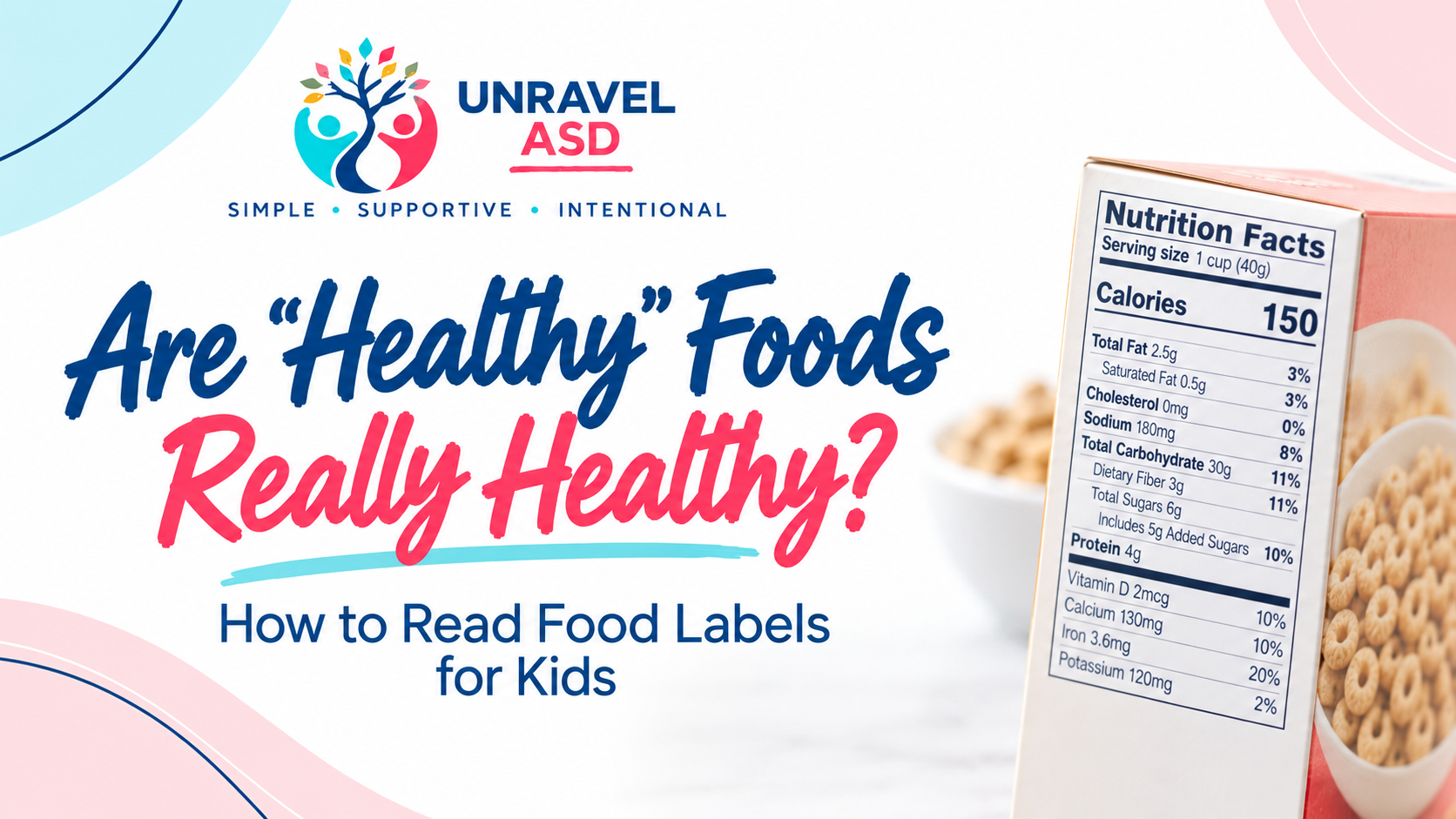
Are “Healthy” Foods Really Healthy? How to Read Food Labels for KidsFor years, I shopped the way many parents do.
If something said natural, whole grain, fortified, enriched, organic, kid-friendly, or “made for growing children,” I assumed I was making a better choice.
Then I started reading the ingredient lists.
That simple habit changed the way I shop for my family.
I realized that the front of a package is primarily where a product is marketed. To understand what I'm actually buying, I need to turn it around and look at the ingredient list and Nutrition Facts label.
That doesn't mean every packaged, fortified, or enriched food is unhealthy.
It means parents deserve to understand what's actually in the foods they're bringing home.
Food packaging can be persuasive.
Words and phrases such as natural, made with whole grains, fortified with vitamins, no artificial flavors, organic, and good source of vitamins can make a product sound like an obvious choice.
But one claim on the front doesn't tell you everything about the food.
Two products sitting next to each other can have very different:
That's why I encourage parents to look beyond the marketing and read the actual label.
The ingredient list tells you what was used to make the food.
Ingredients are generally listed in descending order by weight, meaning the ingredients present in larger amounts appear first.
You don't need to recognize every scientific-sounding word or become an expert in food chemistry.
Start by looking at the overall picture.
What's listed first?
Where are the added sugars?
Is the product made primarily from foods you recognize?
Have vitamins and minerals been added?
How does it compare with another version of the same food?
Reading labels becomes much easier once you stop trying to determine whether an individual ingredient is simply “good” or “bad” and start comparing the product as a whole.
These two words appear frequently on food labels, but they don't mean exactly the same thing.
Fortification generally refers to adding nutrients to a food.
Enrichment generally refers to adding certain nutrients back to a food, often after processing has reduced their original levels.
Fortification and enrichment have played important roles in public health and preventing nutritional deficiencies.
But they also mean that a child may receive the same nutrient from several different sources throughout the day.
For example, nutrients may come from:
Whole foods + enriched foods + fortified foods + beverages + multivitamins + individual supplements
That doesn't automatically make those foods inappropriate.
It simply gives parents another reason to look at the child's overall nutritional intake rather than evaluating one product in isolation.
Whole foods naturally contain combinations of nutrients and other food components.
A strawberry isn't simply vitamin C.
Beans aren't simply folate.
Salmon isn't simply vitamin B12.
Foods can provide combinations of protein, carbohydrates, fats, fiber, vitamins, minerals and other naturally occurring components.
A fortified product may have specific vitamins or minerals added during manufacturing.
Both can contribute nutrients to the diet, but they aren't nutritionally identical simply because the front of the package lists the same vitamin.
That's one reason the Unravel ASD Method™ emphasizes whole-food foundations whenever practical.
It can.
Vitamins can exist in different chemical forms.
For example, vitamin B9 may appear on a food or supplement label as folic acid, folinic acid, or methylfolate.
Vitamin B12 can also appear in several forms, including cyanocobalamin, methylcobalamin, hydroxocobalamin, and adenosylcobalamin.
These aren't simply different spellings for the exact same compound.
You don't need to memorize every form.
The important takeaway is that the name and form of a nutrient can provide additional information about what you're actually consuming.
→ What Are Active Forms of Vitamins—and Why Do They Matter?
Not necessarily.
A shorter ingredient list can sometimes make a product easier to understand, but the number of ingredients alone doesn't determine whether a food is nutritious.
A food with ten ingredients isn't automatically worse than one with five.
Instead, look at what those ingredients actually are and consider the entire nutritional profile.
That's an important distinction because the goal isn't to make parents afraid of ingredient labels.
The goal is to help parents understand them.
This is one of the simplest changes you can make while grocery shopping.
Instead of asking:
“Is this food healthy?”
Try asking:
“Which of these options better fits what I'm looking for?”
Then compare them.
Look at what makes up the majority of the product.
Compare things that matter for that particular food, such as protein, fiber, added sugar, sodium and saturated fat.
Two labels can look very different simply because they're using different serving sizes.
Look for words such as fortified and enriched, and check the ingredient list for added nutrients.
Don't choose something simply because one ingredient sounds healthy.
And don't reject something simply because one ingredient name sounds unfamiliar.
Look at the whole picture.
Once parents start reading labels, they often notice how many foods contain added vitamins and minerals.
Then add a children's multivitamin.
Then perhaps an individual vitamin.
Then another nutritional product.
Suddenly, the same nutrients may be coming from several different places.
That's why I encourage parents to consider the entire nutritional routine before continuously adding more.
→Why “More” Isn't Always Better When It Comes to Children's Nutrition
The Unravel ASD Method™ isn't about creating a perfect diet.
It's about making the child's foundation easier to understand.
Our approach focuses on:
Food • Digestion • Routine • Skill Building • Progress Tracking
Food comes first because it gives us somewhere practical to begin.
We can look at what the child is already eating, identify patterns, make intentional swaps where appropriate, and simplify the routine before adding unnecessary complexity.
Then we can look at what happens after the food is eaten.
That's where digestion becomes important.
You don't have to completely overhaul your pantry overnight.
And you don't have to be afraid of packaged foods.
Start by becoming a more informed shopper.
Turn the package around.
Read the ingredient list.
Read the Nutrition Facts.
Compare similar foods.
Notice where nutrients are coming from.
Look at your child's overall diet rather than judging one individual food.
And make changes your family can realistically maintain.
At Unravel ASD, our goal isn't perfection.
It's helping parents make choices that are:
Simple • Supportive • Intentional
Once you start paying attention to what goes into the body, the next question is:
What happens after your child eats it?
Healthy nutrition isn't only about choosing foods. The digestive system also has to break those foods down and make nutrients available for absorption.
That's why digestion is the next part of the foundation we explore.
→ Why We Prioritize Digestive Support First
🌿 What “ASD” Means to Us
At Unravel ASD, ASD stands for All Symptoms Diagnosed.
We believe every child’s journey is unique — and total wellness starts with understanding the whole picture. Our products are created to support balanced nutrition, digestive health, and overall well-being — helping families simplify wellness through education and natural support.
Unravel ASD supplements and resources are not medical treatments. They are designed for total wellness and educational purposes only.
Unravel ASD™ supports total wellness through nutrition and education. "ASD” stands for All Symptoms Diagnosed — a holistic approach to understanding every child’s needs. Our supplements and materials are not intended to diagnose, treat, cure, or prevent any disease.