
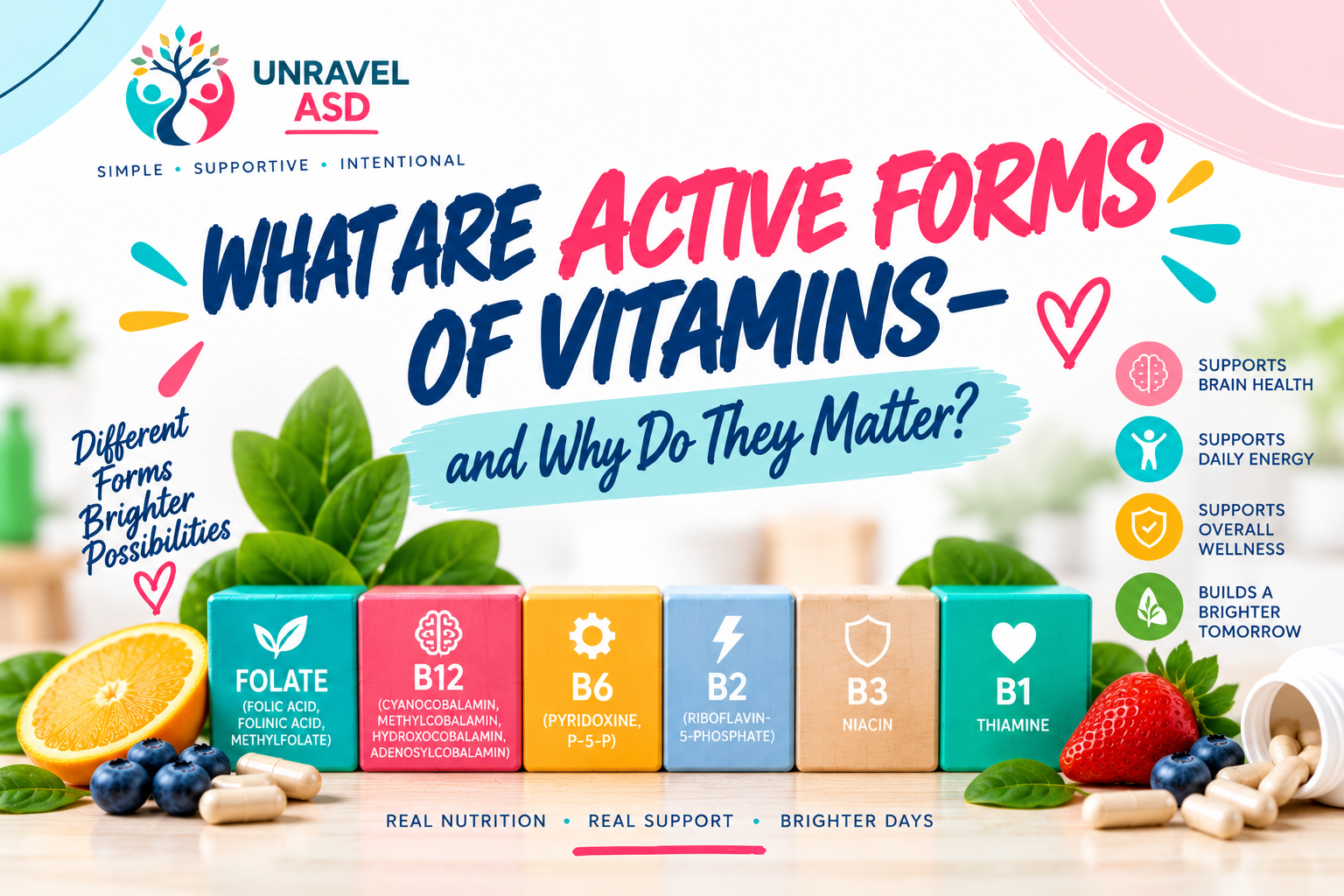

If you've ever compared two supplement labels, you may have noticed that the same vitamin can appear under very different names.
One supplement may contain folic acid, while another contains folinic acid (5-formyltetrahydrofolate calcium). Vitamin B12 may appear as cyanocobalamin, methylcobalamin, hydroxocobalamin or adenosylcobalamin. Vitamin B6 may be listed as pyridoxine or pyridoxal-5-phosphate (P-5-P).
They're all vitamins, so why are there so many different forms?
The answer is that vitamins can exist in different chemical forms, and the body doesn't necessarily process every form in exactly the same way.
Understanding those differences can make supplement labels much easier for parents to navigate.
Vitamins often go through metabolic processes in the body before participating in normal cellular functions.
Some vitamin forms are already in, or closer to, forms used in particular biological pathways. These are sometimes described as active, coenzyme or metabolically active forms.
Other forms may need to be converted by the body first.
That doesn't automatically make one form “good” and another “bad.” It simply means that the form listed on a supplement label matters, particularly when you're comparing two products that appear to contain the same vitamin.
Here are a few you may encounter when reading supplement labels.
Vitamin B9 can appear in several forms.
Folic acid is the synthetic form commonly used in fortified foods and many supplements.
Folinic acid is another form of folate. On a Supplement Facts panel, it may appear as 5-formyltetrahydrofolate calcium.
Methylfolate, commonly called 5-MTHF, is another form of folate.
Folinic acid and methylfolate are not the same compound, even though both are sometimes grouped together in conversations about active folate.
This distinction has become particularly important as more parents encounter discussions about folinic acid and leucovorin.
Related reading: Folinic Acid vs. Leucovorin: What Parents Should Know →
Vitamin B12 is another good example.
Supplement labels may contain:
Cyanocobalamin
Methylcobalamin
Hydroxocobalamin
Adenosylcobalamin
These are different forms of vitamin B12.
Vitamin B12 contributes to normal red blood cell formation, nervous-system function and energy metabolism.*
Rather than looking only at the number of micrograms of B12 on the front of a supplement, look at the Supplement Facts panel to see which form or combination of forms the product actually provides.
Vitamin B6 also exists in multiple forms.
One you'll commonly see is pyridoxine hydrochloride.
Another is pyridoxal-5-phosphate (P-5-P), a coenzyme form of vitamin B6.
Vitamin B6 contributes to numerous normal biological processes, including protein metabolism and nervous-system function.*
Again, the point isn't that parents need to memorize complicated chemical names.
It's simply to understand that two products labeled “Vitamin B6” aren't necessarily formulated identically.
When you're comparing supplements, the amount of a nutrient is only one piece of information.
The Supplement Facts panel can also tell you:
Which form is being used?
Is there more than one form?
Is the vitamin being provided by itself or alongside complementary nutrients?
How much is provided per serving?
What other ingredients are included?
These questions give you a much better picture of a supplement than simply looking for the product with the highest number on the front of the bottle.
This is especially important.
Once parents begin learning about vitamins, it can be tempting to assume that a higher dose automatically means a better supplement.
That's not how nutrition works.
Nutrients have different functions, recommended intake levels and safety considerations. Individual needs can also differ based on age, diet, medications and health circumstances.
The goal shouldn't be to collect the highest-dose supplements possible.
The goal should be to understand what you're using and why.
Related reading: Why “More” Isn't Always Better When It Comes to Vitamins →
This gives us another internal link to one of your existing articles once we optimize it.
Within the Unravel ASD Method™, we emphasize whole-food nutrition first.
Supplements are meant to supplement the diet, not replace it.
When nutritional supplementation is appropriate, we believe parents should understand the nutrients they're providing, including their forms, amounts and role within the child's overall routine.
That's why our approach isn't simply:
“Add more vitamins.”
It's:
Understand the foundation. Make intentional choices. Keep the routine simple. Track what you observe.
This philosophy also influenced the formulation of BrainyBiotics™ Advanced B Complex.
Rather than focusing on a single B vitamin, BrainyBiotics™ combines several B vitamins in one liquid formula, including:
Folinic Acid — provided as 5-formyltetrahydrofolate calcium
Vitamin B12 — including methylcobalamin, hydroxocobalamin and adenosylcobalamin
Vitamin B6 — including pyridoxal-5-phosphate (P-5-P)
Vitamin B2 — including riboflavin-5-phosphate (R-5-P)
along with B1, B3, biotin and pantothenic acid.
It's designed to provide comprehensive B-vitamin nutritional support in a simple liquid format that can be incorporated into an existing daily routine.*
→ Explore BrainyBiotics™ Folinic Acid + Active B Complex
Even a thoughtfully formulated supplement doesn't replace the fundamentals.
A child's everyday foundation also includes:
Food • Digestion • Routine • Skill Building • Progress Tracking
Those pieces work together.
For some families, nutritional supplementation may be one part of that bigger picture.
The goal of the Unravel ASD Method™ is to make that picture easier for parents to understand and implement without turning everyday wellness into an unnecessarily complicated routine.
Simple • Supportive • Intentional
These statements have not been evaluated by the Food and Drug Administration. This information is for educational purposes and is not intended to diagnose, treat, cure or prevent any disease. Discuss dietary supplements with your child's healthcare professional.
🌿 What “ASD” Means to Us
At Unravel ASD, ASD stands for All Symptoms Diagnosed.
We believe every child’s journey is unique — and total wellness starts with understanding the whole picture. Our products are created to support balanced nutrition, digestive health, and overall well-being — helping families simplify wellness through education and natural support.
Unravel ASD supplements and resources are not medical treatments. They are designed for total wellness and educational purposes only.
Unravel ASD™ supports total wellness through nutrition and education. "ASD” stands for All Symptoms Diagnosed — a holistic approach to understanding every child’s needs. Our supplements and materials are not intended to diagnose, treat, cure, or prevent any disease.